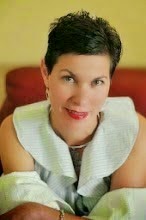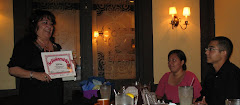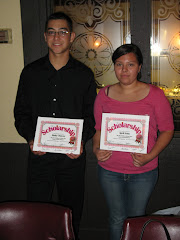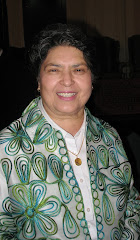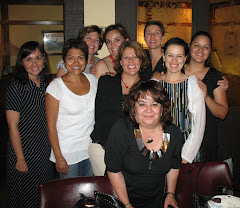
 I´m always looking for contemporary Chicanas who have found their voice and are sharing it with others. Recently, I caught up with two Chicanas who are out there breathing life into their cultura. The first Chicana (at bottom), Candice "Chiquitita" Reyes, sings her heart out any chance she gets. I caught up with her a couple of Wednesdays ago at a sushi restaurant on the East side of El Paso, Texas where she sings with her ban "The Candice Reyes Quintet." I´ve known Candice "Chiquitita" for about 3 years now and has proven to be a chica with SOUL...con alma. One afternoon after swimming a couple of laps together, she insisted I go salsa dancing with her to an eastside joint. I expressed my concern, "Hijole chica, I´m not very good at salsa dancing. I´m more of a Tex-Mex kinda chic." And before I could say "otra vez," I had high heels on my feet and we were practicing salsa in my living room. At the dance hall/bar, her mom´s group, AZUCAR was playing some great salsa music. I didn´t dance much, but Chiquitita got out there and danced. Not only did she dance, she got on stage and sang a couple of songs with her mom.
Since I know she's into singing and performing, I asked her, "What do you think about the reality show American Idol?" (My take on American Idol is that it's a show in America that feeds our youth with the idea that people just show up to a try-out, sing a line or two from a popular song, and a couple months later be famous. This feeds the "anything worth going for can be accomplished in months...Wrong!). Candice answered by first telling me about the time she won the El Paso Idol and got a trip to San Diego to try out with Simon and his crew and represent El Paso. "What a crock.." she said about the show."It´s all political. It´s rigged. It´s a waste. People think that you can be a rock star without hard work." We continued our conversation. She stated how glad she was to have had the experience and learn that it's gonna take a lot more than a simple try out. This month, Candice will be applying at Southwestern State in Texas to the Jazz program to study music. She wants to be a BIG name someday, but she won´t fall for the lies of the American Idols. ¡Adelante, Chiquitita!
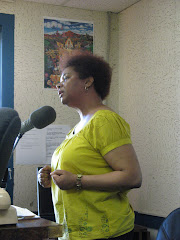
Next is Amalia Ortiz. She traveled from her home in California and presented her Chicana slam poetry at UTEP to raise money for women´s causes. Before the show, she had a writer´s workshop. It was more of a presentation about Slam poetry than a workshop, but Amelia presented her poem "Otra Esa of the Public Transit. " I went to the workshop just to meet her. Her presence as a poetisa is electrifying. Each word delivered during her poetry recital is carefully twirled, counted, and flung into the air with a true Chicana accent. She represents a voice in the world of Chicanas that lifts voices many times forgotten. In the video below, she presents her poem whose title I'm not sure of, but she repeats a line "Me acuerdo de mi hogar, la tierra, el aire, el mar..." Yo tambien me acuerdo, Amalia.
This poem carries a hint of Anzaldua and Little Joe! As well, it speaks of linguistic colonization! What theorists express in convolutions at times, Amalia expresses in poetry.
¡Adelante, Amalia Ortiz!
Nationwide spoken word sensation Amalia Ortiz remembers her South Texas roots.
Friday, February 22, 2008
Chicanas Con VOZ


Monday, February 11, 2008
Mi Vida Mestiza...
"Indigenous like corn, like corn, the mestiza is a product of crossbreeding, designed for preservation under a variety of conditions. Like an ear of corn - a female seed-bearing organ - the mestiza is tenacious, tightly wrapped in the husks of her culture. Like kernels she clings to the cob; with thick stalks and strong brace roots, she holds tight to the earth - she will survive the crossroads."
Gloria Anzaldúa from the chapter of Borderland "La conciencia de la mestiza"
Memoria Mestiza
"¡Ya vamos ha comer! ¡Lávense sus manos!" my mother would yell from the back door of our house. Me and my brothers would come running in from outside ready to eat. We´d been running up and down the alleyways of San Angelo, Tx. on Tulane St. We played with kids named Trisha Holloway, Alex Tresler, Kim Cole, and Bret Miller. Running home each evening, I knew something was different about me and my brothers. As a young girl, I knew they didn't know the real me. I don´t ever remember telling them that my mom was Mexican and that we listened to Mariachi music like kids today talk about the Podcasts and music videos they watch. I don't ever remember wanting to tell them that we spoke Spanish at home, and that my favorite grandmother lived in El Paso, Tx, the Mexican border town. I knew some how that they would not understand. I knew somehow they wouldn´t think that it was "cool." We had the same skin color, but that was all me and neighborhood kids had in common. I just knew in my soul that I was different.
After serving the drinks and setting the table, we would sit down to dinner. My dad would choose one of just to bless the food. "Cristina," is all he would say and I knew to say the prayer on cue. "Nuestro bendito padre celestial te damos gracias por esta cena. Bendisela que de salud y fuerza a nuestros cuerpos. Te pedimos una bendicion para Gran´ma y Gran´pa Devereaux en California y tambien para Gran´ma Gonzalez en El Paso. Cuidalos y bendigalos. Tambien, bencie los hermanos y sus familias de la iglesia. Bendiganos mañana en escuela que nos valla bien. Te pedimos estas cosas en el nombre de Jesucristo...Amen." As soon as I said amen, the hands would shoot forward to grab the best chicken leg or to sip the Koolaid. The talk at dinner would go from school to who we were playing with that evening and what time we should come back after the meal. Dinner time was spoken all in English.
After the meal, my brothers would rinse their dishes and run back outside. I would scramble into the living room, sit down next to my dad in front of his homemade stereo and watch him select the music album of the evening. My father served a Mormon mission in the early 1960's in Mexico, right at the end of the siglo de oro. My father fell in love with the music, people, food, and culture. He brought that love home to us. Some nights it was Barry Manalow, and we´d buggy down to Copacabana, or Perez Prado and do a bit of Mambo No. 5. "Dad, let´s listen to some mariachi." Quiero oír Beatriz, o Lola, or Los Mariachis Vargas or Vicente or un Trio. My dad had all the masters in his collection. With the evening sun streaming into our living room, I was learning all about la música Mexicana. La música mas apasionado en todo el mundo.
And then other nights with the music playing in the background, I would creep into the family room where my parents had built a study station from left to right up and down against the wall. The shelves were stacked with books from American Literature to Encyclopedia Britanica. My favorite books were full of poems by T.S. Eliot, e.e.cummings, and Robert Frost. Poems written about dark things, winter evenings, and love. Poems carrying an Euro-Anglo tint. In my innocence, I didn't know about the radical nature of listening to Mexican singers such as Beatriz Adriana, Lola Beltran or Vicente Fernandez playing in the background while I perused through the pages of great American Literature. The cultural mixings in the evenings of my childhood have made me who I am today. I love good Am. literature (I got my undergrad degree in Am. Lit. and minor in Spanish), and I believe that the Mexican people and their culture live in me and form part of who I am in my memory, each memory of an after dinner time with my father, el profe Devereaux.
Below: Listen to Lola Beltran sing "Paloma Negra." This music stirs my soul... What stirs yours?
Monday, February 4, 2008
Changing the Realities of Downtowns: Alleyway Rhetoric


 This past weekend I visited my hometown of San Angelo, Texas. With a population of about 88,000, it fell asleep for many years forgetting that it had such a rich downtown. Unfortunately, too many towns let their downtowns, the heartbeats of a city, fall into disrepair. Driving around, I pulled into some clean and inviting alley ways! Yes, alley ways. The rhetoric, both visual and verbal, the artists painted on the walls frame the downtowns in a new light. I found this alley way in a historic section of downtown that an artist or group of artists painted their view of what a downtown should look like. The picture with the leaning dilapidated bike shows street rhetoric at its best. The bright red wall reads, "More often than not, I would prefer to walk into the rear alley precisely for all those little hints of life, activity and transition which the placid visual arts of suburbia did their best to politely suppress or politely disguise." More and more, people are realizing that the continuous barrage of capitalistic competition in the form of commercials can wear on one's soul numbing them to life's beauty. And slowly, San Angelo is remembering that they don't have to look to Dallas, Texas for their inspiration and art and that they can grow as their own city.
As a young girl, I remember my father driving us through downtown San Angelo in our green station wagon. Out of the backseat window I saw nothing more than a sleepy central Texas town with tumbleweeds and dust blowing down the sidewalks. "Ugh! I live here?" I thought. "There's got to better," I thought plastering my cheek to the window and dreaming of some better place.
Thursday, January 31, 2008
San Angelo Journalism Conference


 How better to honor former students by bringing them back to their alma mater to talk to current students on how they became so successful? On Thursday January 31, San Angelo State University held a Journalism Day for students to meet four former ASU graduates who have made a successful career for themselves in journalism and/or media. The former students invited were Dan Devereaux, NBC manager, Bhavech Patel a free-lancer audio-editor/producer in Los Angeles, Luis Rios, photo editor at the Miami Herald, and Satsha Pretto, a weekend host of Primer Impacto-Fin de Semana (First Impact -Weekend Edition) on Univision. As I type, all of them are up on stage in a panel answering questions from the faculty moderator and interested students. Each alumni presented power points and personal speeches individually and as pairs earlier to current university journalism and media students. The presenters covered issues of what it will take for current students to get jobs in the journalism or media field. The common thread touched upon by each of the presenters centers on the willingness to take risks. Risks to leave their comfort zones, risks to put themselves up for serious critique, and risks to loose. Each has their stories of sacrifice and hard work.
One of the most valuable assets of the panel rests in its ethnic diversity. Daniel Devereaux, although he has a French last name comes from a Hispanic family; Bhavesh Patel is from Indian descent, born in London and later coming to Colorado City, Tx.; Luis Rios is of Mexican descent also from Colorado City, Tx.; and Satcha Pretto came to the United States from Honduras. The diverse panel speaks to the success of minorities in the area of media and journalism as well as Angelo State University's effort toward promoting ethnic diversity. Bravo!
The panelist who struck me the most was Satcha Pretto. She left her home to attend Angelo State on the university's Carr Scholarship ready to learn and strive as an immigrant and a minority. Sasha listened on as an audience member the first time Dan Devereaux presented here many years ago. He remembered her because she was the only student who expressed serious interest and enthusiasm in a media career. Dan mentioned to Bhavesh years ago to "look out for an up coming talent of Sasha Pretto." And years later, today, she's hosting one of the most popular shows in the Latino market. As a Latina journalist and part time reporter, she holds her own with the three men on the panel bringing her own unique perspective to the struggle of making it in the world of media and journalism. Not only does she radiate beauty, but she also radiates confidence, articulates a mastered English, fearlessness, and a well-rounded education. I celebrate her accomplishments and hope they inspire other young Latinas/Chicanas to strive for their career goals... whatever they may be. ¡Si se puede chicas!
All the participants on the San Angelo Journalism Day panel are an inspiration for all who are searching to reach their goals and ideal positions in life. ¡Adelante!
Tuesday, January 29, 2008
Post-racial Era: I Want to Believe, But...

 I almost rear-ended the car in front of me when I heard Daniel Schorr of NPR use the term post-racial quoting several journalists from the New Yorker and several others use to surmise the state of political landscape as well as our current young generation. The journalists are referring to Obama's surge for the White House and by the looks of the polls and votes, people in America are putting aside their once strongly held beliefs on race and voting for Obama regardless of his color. Many American people see Obama as wise, committed, intelligent, pro-active, idealistic, and honest. They are not blind. I see the same values and nature in Obama, and I cheer on his push to get the nomination. But I strongly question the term "post-racial." I want to believe that racism has slowly been eradicated to be true, but it has not. The media jumps to conclusions without looking at their own publications, quotes, and anecdotes from recent history. Hurricane Katrina opened the curtain on the reality on the inequities of this country. Have the journalists using this term so easily forgotten the scenes? They must live in bubble. Just because we see people of different races mingle peacefully in public places, that does not mean that we are post-racial. It is what we do not see; it is what is not made salient by the press that confirms the fantasy of the term "post-racial." If the fantasy of post racial is seen by people as a reality, then we are living a farce! As a society, we are so ready to see our problems solved, and so when Obama stands in front of our nation asking for presidential votes, we want to interpret his presence as a nation that does not consider race as an obstacle. BUT IT IS. Even his wife, Michelle Obama, stood in front of the nation on the campaign in trail in Nov. of 2007 saying, "I am not supposed to be here" (Obama Speaks with MSNBC's Mika Brzenski). The implicit message there is: "I am a black woman who is educated, and I beat the odds of racism and sexism to get to my position, speaking to you today." She knows it exists. Her material reality speaks of the truth.
Let us not fool ourselves that we have now entered a post-racial era. If we believe that the post-racial era is upon just because Obama won the Iowa caucuses and North Carolina, and that he was won endorsements from Kennedy and other prominent forces, we are blinded by what we do not see in our communities and streets. I maybe a pessimist, but if I believe that we are post-racial, then I believe that I don't have to fight anymore for our students to be aware of the issue, and then I would be the fool.
See also Uzodinma Iwala comments from the Los Angles Times
Saturday, January 26, 2008
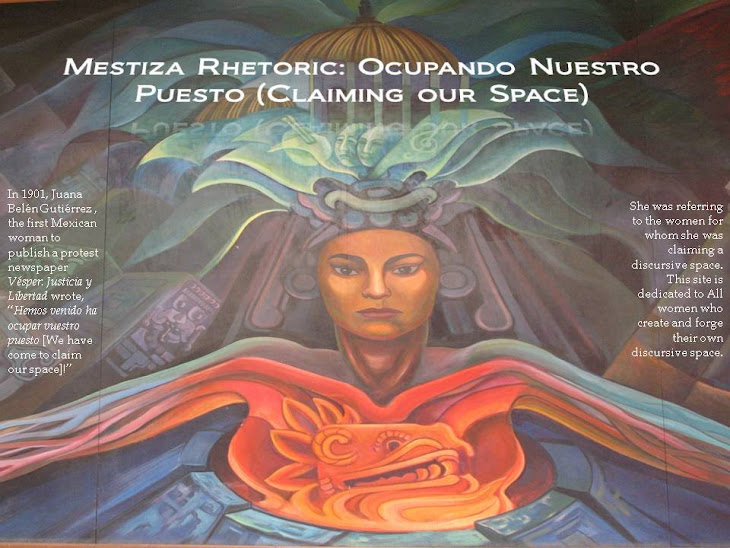
En Memoria del Cumpleaños de Juana Belén Gutiérrez de Mendoza: ¡Por la Tierra y Por la Raza!


Hoy, recuerdo a Juana Belén Gutiérrez de Mendoza. She wrote in her autobiography, "Nací en San Juan del Río, Durango, el nevado amanecer del día 27 de enero de 1875. Este dato debe ser importanitísimo porque lo han anotado con minuciosa escrupulosidad en los registros de la cárcel, cada vez que he estado allí.... Trans. "I was born in San Juan del Río, Durango on a snowy morning on the 27th of January of 1875. This date must hold great importance because it has been recorded with exact scrupulousness in the prison records every time I have been there...." Juana Belén spent her life writing and speaking out against the injustices suffered by her people, the indigenous people of Mexico. This is why her name was recorded in the prison books so many times...her voice threatened the status quo of those who believed it just to abuse the indigenous people for cheap labor. She also spoke out against the inequalities of women in Mexico being on the forefront of the Mexican feminist movement. She lived an extra-ordinary life by traversing the boundaries of possibilities that were socially inscribed for women in Mexico in 1900.
Leaving her beloved homeland and mountain air of Durango, she followed her instinct to start her own protest newspaper Vésper: Justicia y Libertad (Vésper means evening star) and write about the injustices she witnessed growing up among the campesinos y trabajadores mineros (farmers and miners), and which were still plaguing the poor. In am incredibly symbolic action and show of deep dedication, she traded her goat "Sancha" for printing supplies to continue her newspaper in Guanajuato. After almost being arrested in Guanajuato, she fled to Mexico City with her two children continuing her fervent fight on the liberal front of Mexico.
Her sarcastic tone of voice and relentless desire to tell the truth as she perceived it, drew her into the circle of the most influential liberal intellectuals of her time: The Magón Brothers, Juan Sarabia, Librado Rivera and others. Later, she was accused by Ricardo Flores Magón of not upholding to the liberal ideas of the nation, and in a response in her newspaper, she displayed her rhetorical astuteness. "Las palabras que como lema lleva mi periódico, no las he puesto allí como adorno: las he puesto para que normen la conducta de mi pulicación. ¿Puede Ud. decirme que hay algo injusto o antiliberal en Vésper, creo que no." The words that my newspaper holds as a motto, I have not chosen them as adornment: I have published them as a guiding framework of conduct for my newspaper. Can you tell me what is unjust or antiliberal about Vésper, I believe not." Juana Belén held presented her own thoughts and perspectives in a time when women were only to speak on domestic issues, not political issues, let alone critique and personally attack the govern and its dictator, Porfirio Díaz. Her greatest legacy though rests in that she never was swayed from her beliefs; she claimed her discursive space and did not give it up. Politicians tried to buy her silence; but she kept her honor intact and accepted no bribe. She would later fight for the cause of the Mexican Revolution under Zapata who gave her the ranking of Colonel. Later, she was to work with the famous philosopher José Vasconselos as maestra rural leading the charge to educate the indigenous people and to prove to the people of the city that they were people endowed with dignity and strength.
The end of life summed up the gratitude that Mexico had for the efforts of women in the Revolution and social betterment. Juana Belén was forced to sell her printing press and ultimately her typewriter to buy medication for her young granddaughter. Eso no es la justicia ni la libertad. That ending is neither justice nor liberty. She has left us though with an abundance of words, knowledge, and history that on this day I celebrate and remember.
¡Viva México! ¡Viva!
¡Viva la mujer independiente! ¡Viva!
¡Viva el amor y bondad para el ser humano! ¡Viva! ¡Viva!
¡Viva la memoria de Juana Belén! ¡Viva! ¡Viva!
¡Que viva la raza, la jente de la tierra, y la jente que labora por lo bien! ¡Viva! ¡Viva! ¡Viva!
Pictures:
The pictures above: first to the left is a picture of Vésper´s title featured in the newspaper La Bandera Roja, the next picture is a skyline view of Durango, Mexico from the top steps of the public library, the picture furthest to the right is a mural at the Universidad de Juarez en Durango, and the bottom picture is a Día de Los Muertos altar that commemorates those who have passed.
Thursday, January 24, 2008


Tuesday, January 22, 2008
An Islamic Feminist Wave?
 As a Latina feminist scholar, I would be ignorant to ignore the struggles and successes of my other ethnic sisters. In celebrating other women rhetors, I celebrate the mestizajezation of rhetoric!
Listening to NPR this morning (as I always do) I heard the story of Seyran Ates, a German-Turkish Muslim women´s rights lawyer in Berlin who has been extremely vocal on the issues of Muslim women in Germany and beyond. In the past she has fought for Muslim women´s rights to be divorced from their husbands, all at the risk of her own life having suffered beatings and threats in the past. I wondered about the issue of women in Islam and how the world is beginning to deal with the brutal treatment of Islamic women that are no longer under the protection of an Islamic rule in an Islamic nation? I found several surprising internet sites that show Islamic women stepping out of their traditional roles, and asserting a new Islamic women's identity. At the same time, I found Islamic women reasserting their traditional roles, such as wearing the hijab in place such as England that has seen a surge in Islamic population. There are various websites and books out on Islamic Feminism. Shaheen Sardar Ali Human Rights and International Law: Equal Before Allah, Unequal Before Man? (2000); Nayereh Tohidi Women in Muslim Societies: Diversity Within Unity (1998). Is this a Feminist Wave that we are not noticing? Should we take note of these women and further their cause. Certainly, there will never be a true democracy in the Middle East nations if the government, local and global, doesn't take note of the suffering women are subjected to there.
The United States government seems to ignore the issue of human rights regarding women in the Middle East, where they merely see profits and oil. I hear very little from the main stream media about the women's suffering in the Middle East. It seems to me that the topic of women's suffering for many media outlets is a topic best left untouched because of the already tumultuous political situations.
Saturday, January 19, 2008
América Ferrera: A Latina´s Vote

Last night while watching Entertainment Tonight, (yes, we finally purchased a television after 5 years without one, but that's for another blog), I saw that America Ferrera, named in Time Magazine as one of the100 most influential persons for 2007, is out on the campaign trail with Hilary Clinton. I have heard several times through out the campaign in interviews with both Obama and Clinton, that they don't want voters to see their race or gender, but gender and race is at front and center in 2008. When candidates allow high profile celebrities like Oprah Winfrey and now America Ferrera to speak for them in public, it negates their statements that they don't want race or gender to be part of the issues. Having an influential white woman and black man standing before our nation and saying, "Vote for me!" there is definite change in the political air. It was only 40 years ago that Dr. King was fighting for the civil rights of the black community, and only 40 years or so ago that women declared the first wave of feminism. So how can this race NOT be about deeper issues of race and gender? Well it is. A Latina friend of mine asked me, "Why are you blogging on América Ferrera?" That's a good question my friend. I saw that she was part of the Clinton entourage and she caught my eye. I hadn't seen her on Ugly Betty because I didn't have a television at the time, and I usually don't watch sitcoms AT ALL. So I did some research on her, googled some of her pictures, and I was pretty impressed. First of all, her cultural roots are Honduran. But to focus on the surface stuff, she is not all glam that with so many stars is really a put on and a sham! Check her out! She's got carne on her huesos! She hasn't (and I hope she doesn't) gone out on these weight loss crazes to look anorexic or strung-out-on-drugs thin. She has stayed grounded. She knows who she is, a Latina (we are not toothpicks) and she's not going to change (again, I hope she doesn't). And what beyond her looks makes her a role model? She's not banking on her looks and Hollywood to carry her through life, she's studying International Relations at the University of Southern California (Miller, Estylo Magazine 35). ¡Adelante! América! More Latinos should take the example: stay in school and don´t get diverted by the false promise of flash and glam and the quick buck!
And so back to the issue of América Ferrera representing the Clinton campaign. Although I love América as a Latina, I have to agree with my husband (we discuss politics at home) and question the role of Hollywood in politicking. Should the movie stars be part of their campaigns? Should they represent a candidate trying to win over the votes just because promoter is famous a celebrity? Again, I have to agree with my husband, that that kind of celebrity representation makes the real issues invisible. What does América Ferrera really know about Washington and what´s going on in the world of politics and beyond? I may be sticking my foot in my mouth, but if she´s anything like most of my college students (or the typical American), not much. In the case of América supporting the Clinton campaign going door to door asking people to vote, it brings one issue front and center. The Hispanic, Latino, Chicano population (whatever you want to label us) has the strength in numbers to make a difference and politicians will do anything to get it! DO they know it? I hope so. But, once the lights are dimmed, and the votes are cast, will the Clintons, the Obamas, or the McCains remember those people they spoke to and shook hands with? Or will they be blinded by the temptation of large corporate giants and lobbyists and forget the people that this government was meant to serve? ¡Hay que ver! We shall see!