Wednesday, May 14, 2008

Guest Blogger: A Rhetoric of Argument and Life

Isaac Campos 05/09/2008

And so it is that the Spring 2008 at UT El Paso has come to a close. The time has finally come to take a deep breath and ask the ourselves “did we learn anything?” The answer is a straight yes when it comes to English.

One of the most notorious, and sometimes annoying, aspects of this writer is his tendency to be critical about just about everything. Almost in every action, almost, I usually like to take a few seconds and think, “why am I doing this?” This question has lead to many astonishing conclusions which sometimes denoted the lack of purpose I had while performing some activities; classes are not any different. When I’m sitting in my room memorizing for the third straight year in high school the same birth date of the same person, I have to wonder, “why am I doing this? And more importantly, “How is this helping me at all?” The answer is, that it is not helping at all.

Eventually the time came for me to wonder, “Why am I in this rhetoric class?” The answer, unlike the history classes in high school, lead me to realize just how much I was learning about writing and the forging of strong arguments. As I read my papers, they did not sound as just an unguided train wreck anymore, but as a real argument. The advantage of using the techniques taught in Mrs. Cristina D. Ramirez’s English 1312 class was clearly seen in my essays.

One of such techniques that bettered my writing was “Stasis Theory” which is a way in which to develop a conclusion. When I included it in my final paper, it was very notorious that the conclusion had greatly improved compared to the regular conclusion I developed for my essay. Stasis theory is only one of the many argument-strengthening techniques I learned in English 1312.

Besides improving my writing, the class also taught me to be more aware my surroundings. How so? Well, for one thing, it may be become more aware of the deluding arguments advertisers sue to convince us to purchase their product. Understanding these arguments allowed me to become nigh “immune” to their rhetorical techniques. Another aspect of the class that made the most impact on this writer would be the way in which rhetoric impacts and can impact our lives.

Back in the age of the Greeks, some of the wise ones of their time set themselves to propagate rhetoric throughout the land. They wanted to do so to provide the people of their time with the means to defend themselves in the everyday life. This class has accomplished so by providing the techniques that allowed this writer to canalize the feelings and sentiments inside of him and make them a convincing argument. This aspect is very much crucial for any conversation or form of writing; being passionate about a subject will only get you to a certain place, but not towards victory over the opposite side, which what we all want, right?

Besides all of the techniques, which already justified the class, I can most certainly attest that I greatly enjoyed the time I spent writing about the rhetoric of video games. The way the general consensus is right now, few if any teachers would have allowed me to write something about video games; I was allowed to do so in this class. What better thing to write about than my favorite hobby?

Hence, because of the ample amounts of useful information that I learned, and because of the great time I had all throughout the semester, let us conclude that the class was a success. 1312 not only changed my writing, but it also changed the way I looked at my surroundings. Hence, it is also possible to conclude that English 1312 was indeed rhetorical.


Monday, May 5, 2008

Guest Blogger

Oscar Veliz. 05/05/2008
Already the end of the semester has come leaving some gladness and some sadness. Gladness being that I'll get my Saturdays back and will be able to sleep in after the long week. Sadness being that I'm going to miss Prof. Ramirez's unique English class.


It is not very often that I'm shocked at what is in my syllabus because normally they all read the same. Quiz this day. Paper due that day. Test in a week. And Final on whatever future day. This class had something that I did not expect out of the gate, a blog. At first I was apprehensive with creating my own blog, thinking "What am I going write about?" All I really needed to do though was take the plunge and set up an account on Google. Once I started using Blogger and realizing how simple it was to use, the blog pretty much wrote itself. Visit my blog here.

Of course we had class as well with some required readings. Most of all of which were about rhetoric. Go figure. An actual definition of the word is hard to nail down because I have my own that I'm used for my research paper, as does every other member of the class. As a whole, we created a working definition that stated "rhetoric is an epistemic art created by a rhetor for the purpose of change." As a class we learned about ethos, pathos, and logos; which we've all learned about in high school but not nearly the level that we utilized it in this class. The easiest element for me to grasp was logos/fallacy mainly because I'm a computer programmer so I use a lot of logic to solve problems and write programs. Pathos and Ethos I still mix up from time to time even though Prof. Ramirez hammered them into my skull.

I think that the part of the class that sticks out in my mind is that we always used technology. Whether it was the simple use of a projector for notes or posting syllogisms on WebCT, listening to NPR to analyze an article's rhetorical elements, reading New York Times articles, doing research for our research paper, etcetera. We each created a video essay representing the change in our topic over time, for our research paper, using PhotoStory.

Speaking of research papers, mine is on Sherlock Holmes and how he is rhetorical. Surprisingly, even though Sherlock Holmes is found in the world of fiction, he is very much real to many people all over the world from the United Kingdom to the United States to Japan to India to Russia. There are Sherlock Holmes societies everywhere devoted to studying Sherlock Holmes Canon and have scholarly discussions regarding him. In the US there exists the Baker Street Irregulars (BSI), who publish a quarterly journal with various scholars submitting articles. I selected one of the articles in this publication to analyze its rhetorical elements for this class.
After the middle of the semester I'd started noticing that almost everything I saw, read, or heard had some sort of rhetoric in it. Whether it be bottle water advertisements or segments I'd seen on the news. More often, I started to question if everything I heard is valid. Normally checking a statement for fallacies or one-sidedness. In fact, I think I've always done that, but now I have a term, a definition for this analysis and I've come to begin thinking more critically.

As the semester comes to it's conclusion, I realize that this class has grown on me and that I may have grown because of it. Even still, I'm going to like having my Saturday's back.

Saturday, May 3, 2008

Dulce Recuerdos de mi Abuela: Ramona Gonzalez (Jan. 6, 1906 - May 5, 1994)


May 5 marks the anniversary of my grandmother's passing from this physical world.


I lived with my grandmother the last five years of her life. Every morning right at 6:45, she would get up, boil some water, make a cup of instant coffee, and sit down and eat a pan dulce. While playing cards later in the afternoons, she would look at me, a wild eyed and energetic college student, and confess "You know I steal energy from you." Silence. The click from the edges of the cards being placed on the table would resonate through the kitchen. Not once did she look up from her game of solitare. I glanced at her, noticing the white curtains catching the morning breeze behind her. I would answer, "Ah, si, that´s nice, grandma." I thought that she was a bit strange for saying that, but then again, I felt like taking a nap every day at around 1 pm. Hmmm, maybe she was.

My husband, Alex, says that we live in a disposable society, and that we keep the crap and throw away the valuable stuff. He comments, "As an American society, we are in such a bad place because we throw away our old people letting them rot in old folks homes. Our actions are a sad commentary on our society." Our elders are our connections to the past, and we break that connection when we forget about our roots. I will never forget my abuela, Ramona. She had a gift of knowing how to use language, and could hold a group of people in suspense with her cuentos and chistes.

The sweetest memory I have of my grandmother is my 21st birthday. For my birthday, I wanted to have a get together with my friends at my house where I was staying with my grandmother. Worried that grandma would not want to stick around, I asked her if there was anything I could do to accommodate her. She said no, and that she wanted to meet my friends. The evening of my birthday arrived and my friends started to arrive. Perched in her regular seat at the head of the table, my grandmother was the focus of attention as my friends entered the small house. Each of them approached her and greeted her with the utmost respect. After the food, and after the singing of "Happy Birthday," I cut the cake.

We all sat down at the table and watched as my grandmother said to my Swedish friend Tina, "Give me your hand." She put down her fork piled with cake and extended her hand to my grandmother. She turned my friend´s hand over, palm up, and brushed her hand over it. My grandmother murmured, "Hmmm, muy interestante," and a hush fell over my friends. "What is it? What do you see?" Tina demanded, with eyes wide ready to peer into her future. Grandma preceded to read the lines zigzagging on her hand and fingers. That evening, each of my friends touched my grandmother's hands letting her smooth over their palm and tell them about their future. With each hand she touched, she told a story, and all my friends listened. I think they forgot that it was my birthday party. But that didn't matter. My friends enjoying my grandmother's wisdom was the greatest gift.

Esa noche viene a mi mente hoy dia.

Abuela
- Cristina D. Ramirez

The fragile days I spent with you
the last years of your days
rushed by like the currents of el Río Bravo.
No estas aqui.

Puedo oír tus cuentos y dichos
In my mind
Like echoes through a canyon.
The memories of your words mix with the smells of guiso y calavasas
cooking on the stove.
The knowledge you imparted with me
chases away my ignorance
like the first signs of spring's arrival
on a winter’s afternoon;
Your wisdom resides in me.
Pero tu, no estas aqui.

Before, I would not let the wisdom in,
I thought it to be old-fashioned,
A tattered book with yellowed edges,
abandoned on a shelf unread.

Abuela, me has dejado un gran plato
servido con palabras y memorias
De tu juventud.

Abuela, I feel you now,
Como el sol en las espaldas
De una mujer sin blusa.
I embrace my memory of you
Like a child embraces her mother
For the last time.
Abuela, si estas aqui.


Thursday, May 1, 2008

Cinco de Mayo: Mexican History is American History

Cinco de Mayo seems to be a day for people in America to get drunk, party, have sales at department stores, or take a day off from work. Do they really know what they are celebrating? I don't think so. In 1962 the Spanish, English and French had come to Mexico on the pretext to collecting debt from the Mexican government. While the Spanish and English left, (the Spanish had been defeated in 1810), the French decided to stay. Under Napoleonic rule, the French brought the Prince of Hapsburg, Maximilian and his wife, Carlota. Napoleon's French Army entered Mexico undefeated in 50 years, and invaded Mexico with the finest modern equipment and with a newly reconstituted Foreign Legion. The Mexican people wanted to create their own nation, their own identity; they were not going to stand idly by. On May 5, 1962, a Mexican army of 4,000 sliders faced an army of French soldiers and Mexican traitors who joined the French equaling about 8,000 men.

General Zaragossa ordered Colonel Díaz (who would later become president and dictator in Mexico) to mark with his cavalry, the best in the world, meeting the French flanks. In response to the confrontation, the French did a most stupid thing; they sent their cavalry off to chase Díaz and his men, who proceeded to butcher the undefeated French army. The French did not give up. The remaining French infantrymen charged the Mexican defenders through thick, slippery mud, created by an ensuing thunderstorm, and through hundreds of head of stampeding cattle stirred up by Indians armed only with machetes. By the battles' end, many French were killed or wounded and their cavalry was being chased by Díaz's superb horsemen miles away. (Very interesting side note to history not many people know). The Mexicans had won a great victory that kept Napoleon III from supplying the American Confederate rebels for another year, allowing the United States to build the greatest army the world had ever seen. This grand army smashed the Confederates at Gettysburg just 14 months after the battle of Puebla, essentially ending the Civil War. Could Mexico defeating the French have given unity to our American nation? Nothing is impossible.

The French were not kicked out by any means after the battle. A year later, they occupied Mexico, with Maximilian as ruler. In 1867, Benito Juárez, the first full blooded indigenous national, and his men defeated the French again and expelled them from the country.


So this is why people celebrate Cinco de Mayo. The history connects Mexico and America in a show of force and patriotism that shaped both of our histories, Mexican and American. If we could only do the same today we would be a strong nation and people.
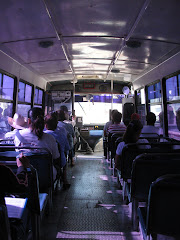
Pictured above: A basketball hoop post. This picture was taken in a colonia of Durango, Mexico.

Tuesday, April 29, 2008

National Hispana Leadership Conference

Vision: Latinas as Ethical World Leaders
Mission: To develop Latinas as ethical leaders through training,
professional development, relationship building, and community and world activism.
Latina Empowerment Conferences
Camino Real Hotel101 South El Paso StreetEl Paso, TX 799018:00 AM to 12:30 PM
LECTURE 2008 Schedule


March 28
Tampa, FL
May 2 El Paso, TX
May 30
Detroit, MI
June 27
Jersey City, NJ
August 22
Seattle, WA
"The Harvesters" by Edward Gonzalez
This Friday I will be attending the National Hispana Leadership Institute. El Paso is lucky that NHLC will be stopping here. As a city situated right on theh border and so far west Texas, we usually get looked over and these conferences end up in places like San Antonio or Dallas. Thank you NHLI for supporting El Paso's Latinas! Thank you for the scholarship to attend the conference as well! ¡Ay nos vemos!
Please stay tuned, I will post pictures and analysis of the conference presentations.

Wednesday, April 23, 2008

Robert N. Gaines Scholarship Fund


Checking email on Monday morning usually means opening reminders for meetings, possible bills that are sent electronically, lists of requirements for the next semester. But this past Monday, I got an email from Ned O'Gorman Ph.D. at the University of Illinois - Urbana Champaign saying, "Congratulations! You have been awarded a one-year membershp to the American Society of the History of Rhetoric through the Robert N. Gaines scholarship fund."

I don't know about you, but I love getting emails that say Congratulations! especially on a Monday morning. Dr. Carol Clark, our History of Rhetoric I professor at UTEP nominated me for this honor. Thank you, Carol. And a honest, warm thank you to Professor Gaines (pictured above) who teaches out of the Communications Department at the University of Maryland for starting the scholarship. I am truly honored and accept the one-year membership.

Thursday, April 10, 2008

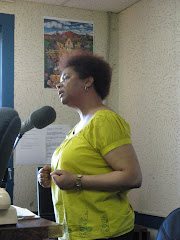
The inspirational quote that appears daily in my google home space today read, "You are the sum of the five people you spend the majority of time with." If the sum of my being includes part of Anita August, author of Gut Bucket Blues, then my personage is blessed and augmented by her contribution Anita came back to El Paso, Tx this week from Washington, DC to promote her book giving interviews at KTEP with jazz expert Denis Woo (pictured above in sound room), and then presenting her book last night at a reading coupled with live jazz (book cover and program above) I sat in on the interview she had with Denis, and her true spirit emerged She talked about jazz music, art and her years at Cal State Art where she started the book. Unfortunately, Denis didn't read the book because it was sold out at the Barnes and Noble on the Eastside of town here, but he grasped the rythm and color of the book without reading a word.


In the interview, Anita spoke of where she gathered the inspiration for telling a story, and it wasn't from a grandmother or mother who told her stories of their past, but from the Bible. Growing up in a Christian household, she only had the Bible to read many times, and so she thumbed through its delicate pages. The story she recounts is the story of the the adulterous woman who was thrown in Jesus's path by men of religious standing. Jesus did not look up from the circle he was drawing in the sand, and asked the men that if they are without sin then they may cast the first stone. None could. And then Jesus said to her, "Neither do I condemn thee; go and sin no more" (John 8:11). Her inspiration, Anita mentioned, came from stories of people who are not perfect, who are flawed, who are freaks. Those characters attract this author because just below the surface, we are all flawed creatures, at times even freaks to those who know us, and to ourselves.

Anita's reading at the Union last night danced. Accompanied by the sweet jazz of Marty Olivas '91 and QBIZM, the guitar of Rembrant Aaron came to life on cue. Her voice at times was drowned by the music, but that made the audience listen even more closely. People were on the edge of their seats. She read... "When Rebrandt finish beating on his guitar he twist half way on the sweet potato basket and signify with 'em vultures eyes to Diamond Dick and Fingers like he ready to pick some bones clean, "Let's get this funk flying in here.

"That's all Diamond Dick and Fingers was waiting on - The Call. Before Rembrandt twist back 'round to the audience, Fingers done already lower the tone with his harmonica. The sad moaning of it pull you from the Butt-Hutt and drop you smack in the middle of the cotton field. An dyou cain't help but see some old niggah pulling a cotton sack down a row of Delta Pine with a busted back, bleeding fingers, and a demon sun standing watch over him" (43-44).

Last night her friends, profressors, and literary buffs celebrated Anita and her very important accomplishment. Her reading flowed like the blues singin' of her inspiration, Bessie Smith. If you like the music of Bessie, buy the book and you'll be treated to language that sings, purrs, moans, and shrieks all at once.


Friday, April 4, 2008

Abriendo Puertas Cerando Heridas [Opening Doors and Closing Wounds]


Have you ever had a dream, and the dream seemed impossible and too far away to reach? ¿Has una vez en tu vida tenido un sueno? Y el sueno se te hizo algo increible, algo imposible alcanzar? Two years ago I dreamed to going of Mexico and presenting my doctoral dissertation topic of Mexican women journalists at the turn of the century. My dream is on the road to becoming reality.


The second semester of my doctoral program, I was taking a class with Dr. Sam Brunk, an expert here at UTEP on the Mexican Revolution and Emiliano Zapata, leader of the southern movement. One day I get an email from Dr. Brunk, "I have a student who would like to write a paper on the women journalists during the Mexican Revolution. Could you help her out?" I write back, "Sure, send her over to me."

In the next couple of days, Celia walks into my life. I am showing her my research on Mexican women journalists from 1900. After I tell her about Juana Belén´s life she interrupts me, "I´m from Durango." At the end of 2006, I go down to Durango with her family and spend the week exploring and learning about Durango. I went completely unprepared...no digital camera, no computer with which to do research. I didn´t know I would find so much.


At the library where they house the Hemeroteca (newspaper archives), I found a newspaper called La Bandera Roja published in 1900. A communist leaning newspaper, the editors and contributors to the newspaper were all anonymous using names of past revolutionary liberalists from Mexico such as Ignacio Zaragoza and Melchor Ocampo. In the newspaper, I found a section where Juana Belén had written to the staff congratulating them for their contributions to the liberalist cause. On that same trip, I made it down to San Juan del Río, Durango, the town in which Juana Belén was born in 1875. During my one day visit, I found Juana Beléns baptizimal records which show she was not given the name of Juana Belén, but María Juana Francisca Gutierrez Chavez. This will be a significant find for my research. With that trip, the Rodriguez family opened doors for me by showing me the ins and outs of the city, and providing a free place for me to stay whenever I am there.

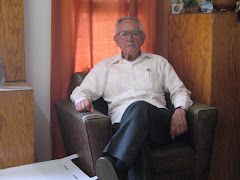
On my last trip to Durango, Mexico (Monday, March 31 - Thursday, April 4), I met with several people who will help me advertise the historical importance of Juana Belén. One the persons I met was totally by chance. On Wednesday afternoon as I was leaving the library, I ran into (literally) a much older caballero by the name of Gonzalo Salas. He was looking through his immense collection he had donated to the library years early for a picture of a Mexican politician on whom he is going to write an article. It turns out that Gonzalo Salas has had an illustrious career in Mexican politics under the PRI and is now the President of Cultural Studies of the city of Durango. He publishes a journal through his department and initiates presentations throughout Durango on history, cultural studies, and more. He invited me for a cup of coffee down the street in Durango. After I told him about my reason for being in Durango, he showed great interest in helping my cause. The next day he met with me with Maestro Óscar Luna, Ramiro Corral, and Miguel Ángel Ortiz. These gentlemen head the Festival of Culture they hold every year in February in Durango under the auspices of La Universidad Juárez de Durango. In our meeting, they expressed interest in publishing my dissertation as well, they would like for me to participate in the Festival de Cultura in February by presenting there at UJED and also in San Juan del Río, Durango. This is a fantastic opportunity to take my research beyond the walls of academe and to people who would truly embrace Juana Belén and her important history as an indigenous to their region. If this all does come to fruition, I would love for any of you come down to Durango for a couple of days and enjoy the beautiful pueblo of Durango.


The title of this post "Abriendo Puertas, Cerando Heridas" comes from Gloria Estafan's song "Refranes" on her new album 90 Millas. She sings about finding her abuela's [grandmother's] notebook that was full of poems and refranes [sayings]. Her abuela's words inspired her to be a better person, to love eachother, respect eachother, visit our family members, etc. Mi abuela also left me words and her spirit has inspired me to cross borders and join cultures reminding each other that we have something special in each of us.

Wednesday, April 2, 2008

Research Trip to Durango, Mexico


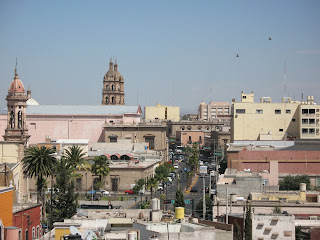
Durango is beautiful! I arrived early in the morning on Monday. Sleeping on a bus next to someone you don't know is never easy! It's all about personal space... Anyhow, as I got off the bus I was excited at the prospects of being here again. I was to have come last week, the week of March 23, but I learned at the last minute that the public library I needed access to was going to be closed due to extened holidays for Easter. My husband laughed at both my arrogance and ignorance as an American. We expect other cultures to conform to our ideas of business, and when it doesn't, we're put out of our ways and consider it an offense. But that's an issue for another blog!
On Tuesday I got up and went to the library, Biblioteca Central de Durango. They city had just come off of two weeks of vacation and were still asleep. Honestly, I did not come thinking to find something new in the archives to include in my dissertation, I wanted to make an effort to promote Juana Belén's voice here in her land among her people. As I was studying in the Hemeroteca (archive room), the director of the library El Maestro Óscar Jimenéz Luna came out to greet me. Let me here insert an cultural nuance about Mexico and its people. Contrary to American understanding, the people are VERY formal and polite. To be accepted in the circles of learning, one must present themselves as having knowledge about the culture and its everyday dealings. El Maestro (they address the director formally as the Teacher) came and greeted me inviting me into his office to speak about the completion of my dissertation. I wrapped up my studies and presented myself in his office.

El Maestro Luna certainly remembered me and my studies on Juana Belén Gutiérrez de Mendoza from the last time I had come to do research. In our meeting he proposed exactly what I had been hoping, to present next year here at la Universidad Juárez de Durango (UJED) during their Cultural Festival. Maestro Luna immediately got his secretary to call the director of the festival to set a lunch meeting for this Thursday at 12. I am hoping all goes well.

Festival de Cultura

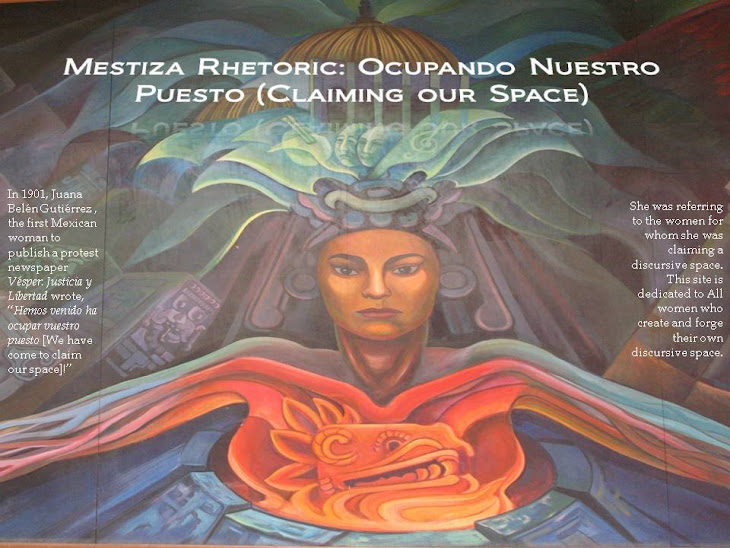
Each year the UJED holds a month of cultural presentations from theater to music to poetry readings. I am hoping next year to reintroduce the city of Durango to their daughter, Juana Belén. Of course everyone, even outside of Mexico, know of Pancho Villa, born also in the same town as Juana Belén, San Juan del Río, Durango. But no one knows her name. I hope to change that sentiment. I hope to bring to light a forgotten history of Durango. I am going to propose several ideas at this meeting with these men of influence here in Durango. First, I am going to agree with Maestro Luna's invitation to present at next years Festival de Cultura. How exciting! (I hope that maybe some of you can come down with me... hgh huh...mom or dad!)Next, I am going to present to them another more lofty plan. As I was wondering through the Governor's Palace and taking pictures of the murals, I realized that Juana's painting as well should be on those walls. And then, another even loftier idea. I am going to suggest they have a bronze made of her and put somewhere in the city. I am going for broke. Tomorrow I will have the undivided attention of the men who move and shake this town. All they can say is no. But so far been very well received!