Friday, July 18, 2014

Progress in Preserving the Past:Biblioteca Pública Central Estatal José Ignacio Gallegos Caballero

A library assistant working to preserve the newspapers.
On my first visit to Durango, the archives were located in the main building of the library called José Ignacio Gallegos Caballero.  Eight years ago, the archive center was extremely well kept, but none of the newspapers were digitized.  I slowly made my way through the stacks and stacks of newspapers to be able to finally find the one's I needed.  That was almost a decade ago.

When I visited last year for the first time in about 4 years, there was a new building just to the side of the library.  To my joy and surprise, it was an archive building.  The Director, Maestro Oscar Luna, told me that they had secured funds from the government for the building.  And, they followed through. 


Archive building in center of image.
It's a three story building.  The bottom floor has a place for cultural and art events.  The second floor houses an impressive collection of antique books. (Oscar Luna told me that each month he chooses a book from the collection and presents on it at the university.) And the top floor houses the newspapers.  They are still not digitized, but they are now in possession of an impressive digitizing machine in order to save all these priceless documents.

For such a small archive in Mexico, they are making big progress.  All of this is mostly due to Oscar Luna's dedication to a work (una obra) that he deeply believes in.
The digitizing machine in the Durango library. 

Thursday, July 17, 2014

Why research in Durango?

Me in 2006 in Durango, Mexico on my first research trip. I am
standing under the arches of El Centro Cultural de Durango.
When ever I talk about my research, I always get the question, "Why did you go to Durango? How did you know to go there?"  Well, I didn't.  There's a story behind how I first came to this beautiful land of Durango, Mexico.

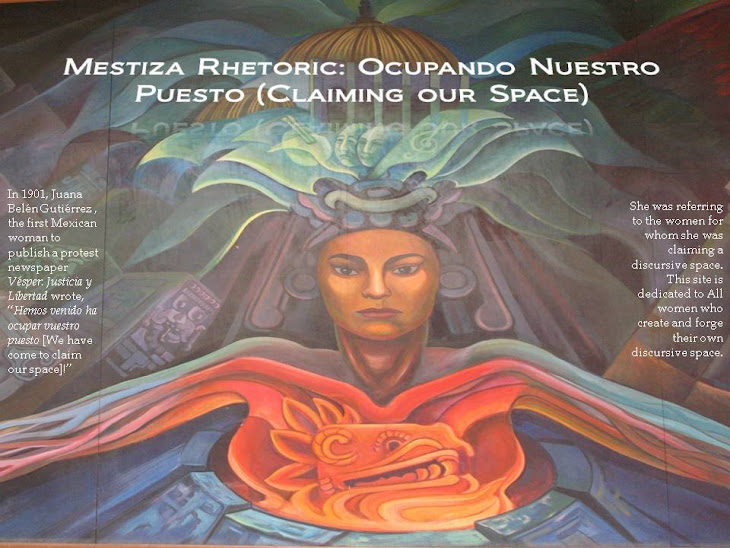
As a graduate student (Fall 2006), I was taking an independent study with UTEP professor, Dr. Sam Brunk (foremost historian on the Mexican Revolution.)  He emailed with the name of student, Celia González, who was interested in writing her term paper on Mexican women journalists.  She came to visit me, and we began to talk about my research.  I told her about one of the women I was studying, Juana Belén Gutiérrez de Mendoza - that she was born in San Juan del Río, Durango in 1875 and that she had been thrown in jail for her first protest articles that were published in 1898. 


At this point in our long conversation, she stopped me.  She said, "I was born in Durango. I still have family in Durango."  I thought, "I'd love to go there and dig into the archives."  I asked if she was going back anytime soon and if she would conduct some research for me.  She one upped me.  Several weeks later she invited me to Durango with her family for Christmas vacation.  Like a dream now, I remember getting on a bus at night in Juarez, México with the González / Rodriguez family and waking up in Durango, Mexico. 

The next week 1/2 in Durango, Celia (who became my research assistant because I was so enamored with the city) and I went through the stacks and stacks of newspaper archives.  On that trip in 2006, I found the document (a feminist manifesto) that is now Chapter 3 of my book.  I have returned several times to not only finish my research, but to also enjoy the warmth of the people and culture I have found here.       

Monday, July 14, 2014

Travel to Durango and Guanajuato, Mexico: Follow Me!

El zócalo in Durango, Mexico.
Some time has passed since my last post on this blog (about 3 years or so).  I'm picking my blog up again for the next couple of weeks to write about my upcoming trip to Mexico.  Tomorrow, I am traveling to Durango, Durango, Mexico (Durango is the captial city of the Mexican state of Durango) and later in the week, I am taking a bus ride south to Guanajuato, Mexico.  Not many people travel to Durango, Mexico, possibly because of the mislead picture that the American media has painted of this region. I do not let fear tactics of the media rule my life.

I have traveled to Durango on several occasions for research on my forthcoing book, Ocupando Nuestro Puesto: Mestiza Rhetorics of Mexican Women Journalists & Activists, 1875-1942 (Spring 2015, UA Press).  I'm returning for several reasons. I want to continue my professional relationship with the public archives, Biblioteca Pública Central Estatal José Ignacio Gallegos Caballero and it's diretor, Maestro Oscar Jiménez Luna.  They have been more than generous in providing access to their resources upon each of my visits. They have given me permissions to use a picture of the Durango library circa 1922 that had images of the first female students from the college, then called Instituto Juárez, now called Universidad Juárez del Estado de Durango.

For the second part of my trip, I am planning on retracing the steps of one of the women I write about in my book, Juana Belén Gutiérrez de Mendoza (1875-1942) took from one region to another.  She left her homeland of Durango in 1900 ánd traveled to Guanajato, Mexico to start her own protest newspaper, Vésper: Justicia y Libertad.  She went with 3 children, Laura, Julia, and Santiago and also her goat, Sancha. The city of Guanajuato was at the time a growing hot-bed of resistance against the Porfirian government and dictatorship, and Juana new she wanted to have her voice be heard. I have never been to Guanjuato, but I plan to find the places where she may have worked from.

I will be posting pictures of places I go, interesting things I see, and people I meet along the way.  Follow me!        
   

Thursday, October 21, 2010

"And a child shall lead them..."


Living along the U.S. / Mexico border, just miles from Cuidad Juárez, which has been called the most dangerous city in the world, I hope and pray everyday that something happens to change the direction of this city and country in peril. I think the winds of change have begun to blow. Marisol Valles Garcia, a 20 year-old student majoring in criminology, married, and with one child, was offered a job that nobody else in Mexico wanted. After the mayor of Guerrero heard her plan on how to make the city safer, he offered her the job of police chief. Shortly after, Marisol was named the police chief of a small town called Praxedis G. Guerrero just 35 miles south of Juárez.

As the police chief, she refuses to carry a gun, but has been given two body guards. She says that her goal as police chief is not to go after the drug cartel but to focus on the community and help disapate their fear of all the violence that has been going on in around their community. Her plan also includes hiring more women to the force not as deputies to enforce the law, but as advocates of the community going door to door building the faith and confidence in the people that they can have a community again.

I have read all sorts of criticisms throughout the interent about how Marisol Valles Garcia is foolish, that she isn't thinking straight, that she isn't qualified, and that she is helpless against the power of the drug cartels. I respond to the naysayers by pointing out the fact that none of the men of Praxedis G. Guerrero applied for the job or have come forward with ideas on how to improve the social health of the community. In Spanish there is a phrase, "son sin verguenzas," which in English means "they have no shame." The men of Praxedis G. Guerrero have no shame in having a young woman step up to a leadership position. She is well aware of the situation she is going into, and sometimes it takes an act of courage, such as Marisol Valles Garcia's, to serve an example to the rest of the world that the only thing to fear is fear itself.

Sunday, December 6, 2009

Dame la Mano: A Class Project


I have been away from blogging for sometime now. Life has taken its course. I started my post-doctoral position as research and writing specialist with the Office of Strategic Initiatives at UTEP, and then a month and a half later I defended my dissertation, Claiming the Discursive Self: The Rhetoric of Mexican Women Journalists, 1875-1924, this July. Since then, I have been just trying to catch up on either sleep or time to read.

Now that I've caught up on life I want to report on my Spring '09 semester. I taught one section of 3355 Workplace Writing and Organizational Communication. The course includes a major project at the end of the semester that asks students to chose a company and write a recommendation analysis/report for upper management. The first part of the course, however, delves into the theoretical bearings of rhetoric and examining businesses through a rhetorical lens. We read Community Action and Organization Change by Brenton Faber, which explains through ethnographic naratives how businesses are discursive constructions, and that in order to alter the direction or reality of a business, that it first must be done through discourse. One of Faber's main critiques in his first chapter deals with the disconnect between academe and university courses and the real business world. Although the students from the Fall '08 semester seemed to have learned a great deal from conducting the analysis/report on the companies, I thought I would take this critique to heart.


Every Christmas Even when I was growing up, my mom and dad would take all of the kids out caroling to families who were less fortunate than us. We would take them food and tidings of good joy. Christmas Eve of 2008 was no different. I stopped by at my parent's house, and they were gathering what they could for an not-for-profit organization they had heard about on a radio announcement that needed food and clothing for battered and homeless women. I loaded myself along with several hams, canned food items, and clothing to take to the shelter. We drove through the lonely streets of Segundo Barrio, an old neighborhood in which mostly Mexican-Americans live and thrive. We found the shelter called Dame la Mano at the very end of the block. There were other good semaritans there loading the front room up with foods, treats for the children, and need toiletries.

The shelter seemed pretty well taken care of by the community of El Paso. I asked for a flier or a brochure that I could have to take home and share with others. The Director, Rose Arellano, handed me a newsletter. A newletter is the first impression of an organization, telling the reader who they are, what their mission is, and what activities are taking place. It should be sharp, well-written, containing vibrant pictures and design to convey the life of an organization. But Dame la Mano's newsletter was anything but. It had mispellings throughout the public document. The paragraphs were not well written and had little relevance to the audience. It only told of the first days of the organization, which had been over 15 years ago.
I asked my students if they were interested in substituting the major research project with a project that would not only get them involved in their community, but also teach them about how discourse shapes and can have transformative powers within organizations. On Cesar Chavez Day, we visited Dame la Mano, and met with the directors of the organization. My students asked what they would like to see in their brochures. What information would be helpful? In what language should they be written? What stories would you like to see in newsletter? These questions gave the students an idea of how to approach their projects.
Groups of students completed their brochures, newsletters, etc. and presented them to Dame la Mano on the last day of class. Beltran Printing here in El Paso donated over 500 brochures and newsletters to the organization. Dame la Mano was extremely appreciative of the class's efforts. This past May, Dame la Mano was invited to the White House to talk about their efforts to help people along the border with their non-profit organization. They were able pass out the brochures and newletters that my class had created to bring more funding and recognition to their work.
¡Esto es el trabajo de la mujer Latina!


Wednesday, March 4, 2009

In Memory of Petra Casas


Today, I remember Petra Casas, grandmother of my best friend, Cythia Casas Bishop. I have known Cindy now for almost 18 years, and our friendship strengthens with each memory we share. We have a special connection in that that we both hold dear and love deeply our abuelas. Cindy was my friend when my grandmother, Ramona Gonzalez was alive. I know Cindy remembers coming over to my house where I lived with my abuelita to eat lunch, or take naps before we kept studying for the night. The fact that Cindy has in her memory images and recuerdos of my grandmother, connects this dear friend to my ancestrial past. In return, I have dear memories of Cindy's grandmother, Petra. (The picture above is from Cindy's wedding to Steve Bishop this past July in Albuquerque, NM. From left, Petra Casas, Cindy Casas Bishop, and Elvia Casas)
Nuestras abuelas nos dan los más dulces momentos y recuerdos de nuestras vidas. Nunca, nunca se nos olvidará de nuestras abuelas.
In Memory - Petra Casas September23, 1923 - February 24, 2009

Tuesday, January 20, 2009

Around El Paso on Martin Luther King Jr. Day


Martin Luther King Jr. Day, January 19, 2009, is a time to remember one of the greatest African-American leaders of our time. But the day is also about commemorating what he stood for: freedom for all people. Monday afternoon I drove down to the non-profit organization, Dame la Mano, and saw some images that reflected the spirit of the day. As I was getting back into my car, I saw a group of children playing in the street. They weren't playing ball or some of the typical street games. They were gathered playing the traditional Mexican bingo game called LOTERIA. I couldn't resist. The sun danced perfectly off road warming the small breeze that blew down the street, and so I sat down next to Kimberly and said, "Yo quiero jugar." The looked at me kinda strange. I'm sure they thought, "Que hace esta señora?" But I played a couple of rounds of LOTERIA with Kimberly, Emmanuel, Caleb, Hillary, and Adan. "El pescado. La pera. El boracho. La dama. El diablito. La muerte. El arbol. La chalupa. El pajaro. El sol. La luna. La corona."


Getting in my car and driving north to go home, I came upon a group of students and community members who were painting a mural on the wall of small grocery store in Segundo Barrio. They are working on a series of murals in Segundo called Heroes de Segundo Barrio. This day, they were working on the mural of El Paso DJ, Steve Crosno. The muralists were Ruben Velez, Eddie Velez, Albert Calzada, Jesus, Jerry Calvio, and Kimberly.

Saturday, January 17, 2009

Another Mexican Revolution in Juarez, Mexico

The year 2008 found Juarez, Mexico in the grips of terror. It has been reported that just over 1600 people were murdered on the streets of Juarez, Mexico. (I wouldn't take this as the official count because I think that there were more!) Already in the first days and weeks of 2009, over 50 people have been killed in Juarez. I've seen the sad reports with the gruesome pictures of people being run over with vehicles to headless corpses hanging from city bridges for the better part of a weekday morning! The people in Juarez are victims of a lawless environment! First, the drug cartel conduct daily murders on the open streets of Juarez. They don't care who they kill, or how they kill. They are sending a message! One would hope that if your city were being terrorized by criminals that the law, the government, or the military would be there to protect them, especially since the people do not have the right to carry a weapon. BUT THEY ARE NOT PROTECTING THE PEOPLE! THEY HAVE TURNED A BLIND EYE TO THE TERRORISM AND HAVE SANCTIONED THE ACTIONS OF THE DRUG CARTEL! So what are the people to do, lay down and allow themselves to be held hostage? NO!


"Evil thrives when good people do nothing," is the phrase my husband, Alex, uses for moments such as the one brewing in Juarez. And good people are rising to the moment. This past week a group of business men released a public announcement telling the poeple that they would be financing a retaliatory movment. They call their group of vigilatantes Comando Cuidadano de Juarez or Citizen Comandos of Juarez or CCJ. They have declared, in so many words, that they are fed up with the terror in the streets of Juarez and are prepared to clean up their streets. They have posted a warning, a line in the sand has been drawn, "a criminal will be killed every 24 hours" until the streets of Juarez are once again safe.


Evil thrives when good people do nothing. There has been a Revolution every century since 1810 in Mexico; this one will make 3! Patria y Libertad!

Friday, January 9, 2009

Mayor Cook Vetos El Paso's Voices

(Picture source, El Paso Newspaper Tree)
We've all heard the saying, "The road to hell is paved with good intentions." This week, El Paso City Council member, Beto O'Rourke, laid the ground work for this journey to HELL! What started out as a resolution to extend EL Paso's solidarity with our sister city, Juarez, Mexico, that has been besieged by unchecked violence, has been converted into a major controversial issue. Beto O'Rourke added an ammendment to the resolution that called for a debate on the issue of the drug war being fought right here in our community. I have not been able to find a link to the resolution, but O'Rourke's two cents on the issue that called for "the encouragement of the U.S. federal government to start a "serious debate" on the legalization of drugs" (El Paso Times).

First, I'd like to commend the EL Paso City Council's Border Relation Committee on trying to bring attention to an issue that to me, seems like it has been swept under the table by the majority of America. But I have to agree with Mayor John Cook and Sylvestre Reyes, who commented on this ammendment, that legalizing the use of mariguana is not the solution to the drug war. Mayor John Cook used his veto power to keep the resolution from moving forward, but the resolution has now made major headlines in El Paso and elsewhere. Imagine what this would bring about in Mexico. The drug cartel, murders, terrorists, and money launders, would now become the agents with whom the governments deal with for access to this drug. And then, can you imagine, not only would out school teachers, doctors, airline pilots, mechanics, for that matter, our city council members, could now not only legally drink their woes away, but smoke a joint with that glass of booze. Is that the solution to all our problems, make the issue acceptable? You're 15 and pregnant, well, that's okay! You robbed a bank, well, that's okay. You cooked your books past the boiling point, well, that's okay. Just stay in your penthouse until we can figure out what to do with you. Ay NO!

First, Mexico needs to clean up their act. The government has been in bed with the enemy; for too long they have turned a blind eye to the issue of drug running. Greed has taken hold of the people in power, and the power of the government should be greater than one of human's weakness. But I'm wondering also, if government isn't the result of human weakness? Are we all to blame? Do we all have blood on our hands? Are we all complacent? "Not my children," we argue.

I'm just wondering what SHOULD be done about the drug war. Is there any ONE solution? I'm going to say that the first step, as city council proposed, that the people on the border are NOT a divided people, and that their problem IS our problem.

Maybe it's time for a SUPER HERO!

Tuesday, January 6, 2009

Local County Commisioner, Anna Perez, Makes Progress

I am sorry to say that I don't follow local El Paso politics. Too many times the citizens of El Paso hear only negative news on the politicians of El Paso from the sad news of fraud by Raymond Telles to the kick-back charges made toward Sal Mena, ex board of trustee in the El Paso Independent School District. Sadly, the list, and the investigations, go on. All too easily, a local El Pasoan can get discouraged and lose faith in our local government. (Picture above from Anna's website, www.annaperez2008.com)

But today, newly sworn in County Commisioner for Eastside Precinct 1, Anna Perez, caught my eye and positive attention. She is a local talent (and on top of being smart, she is Latina) that went to Texas Tech Law School, and has come back to serve and improve her community along the border. She has a long track record of working for the community from issues on mental health advocacy, to outreach for the disabled and elderly. She is the immediate past President of the Mexican American Bar Association of El Paso, and currently sits on the board of the El Paso Bar Association. But what caught my attention is her desire to get things done in El Paso.

The EL Paso Sportspark, a recreaction spot used by many EL Paso families, has been set aside as a project too big to tackle. But Anna Perez has made the park her priority. She is quoted in yesterday's El Paso Times,

"The Sportspark has to get resolved," Perez said.

"It's gone through several administrations, it's been tossed around, and I'm committed to finally getting it resolved for the families who use that park."

ALthough Anna is not my precinct representative, I will be following her, hoping that she can bring a positive air and noteworthy results to El Paso politics that has, of late, been dragged through the muck.

Thursday, December 25, 2008

A Violent Christmas


Millions of Americans lay tucked in their beds, while images of sugar plums danced in their heads. On this Christmas morn', I awoke at 1 am to to sounds of reverberating shot gun fire and small arms fire dancing in the air. As I lay tucked in my bed, I counted 12 shot gun blasts echo off the El Paso Franklin Mountains swooping down into the valley, my neighborhood, below. I knew these were not the traditional celbratory shots fired on Christmas eve, but the violent and deadly messages the drug caretel have been sending for months to those living along the border. How grim to know that at the end of each blast, a man or woman lay dead in the streets of Juárez. I closed my eyes and said a prayer for the families each of the shot gun blasts would effect. They will not be having a Feliz Navidad y Prospero Año Nuevo.

I have been silent on my blog for months because I have been busy with writing and researching for my disseration, but equally as much, I have been speechless about what is going down just a stone´s throw from my home, the university, the place I call home.

For months, the violence has escalated to 12, 15, 21 murders EVERY weekend. The media quotes numbers at 1,400 or 1,500 people that have died in neighboring Juárez, but I believe that the number is much higher. Unmarked graves, a poor tracking system of the people, and an indifference for the Mexicans living on the border hinders an actual count of the people who have lost their lives. Just in the last two weeks, the cartel killed the chief of police of Juárez. The cartel has no respect, no care, no scrupels for the lives of anyone. This week, members of the cartel were throwing the decapitated heads of their latest victims from the window of their trucks! When will this end? The people of Juárez, Mexico cannot defend themselves because weapons in Mexico are illegal! Only the criminals have the guns.

I question the attention this issue has received from not only the American press, but also the American government. A war rages in a country neighboring the United States, and their response is to build a wall. The United States continue to take an indifferent stance toward the suffering and serious issues raging just across our borders. Many people feel may feel think "the killings and drug cartel are their problems." More than we know, the killings and drug cartel are our problems. Why? Fifty percent of the drug consumption in the world occurs here in the United States, for marijuana alone, there are 14.6 million drug user in the United States (www.medicalnewstoday.com). Yes, the killings in Juárez, a drug war fighting for the passage ways to sell their product in the United States, IS our problem.

Wednesday, July 16, 2008

Dr. Scott Lunsford's Dissertation Defense - Public Corrections: The Discipline of Lynne Truss


On Monday July 14, Scott Lunsford defended his doctoral dissertation in Rhetoric and Writing Studies at the University of Texas at El Paso. Dr. Lunsford's excellent dissertation, Public Corrections: The Discipline of Lynne Truss, centered on the grammar book Eats, Shoots & Leaves: The Zero Tolerance Approach to Punctuation by Lynne Truss. Truss, Lunsford argues, erroneously positions literacy as a narrowly defined universal skill, not allowing for alternative literacies. The following is from Scott's dissertation abstract: I look through two lenses to glean what many in popular and academic discourse say about several objects of study that the field of Rhetoric and Writing Studies takes on throughout its own scholarship and practice. First, by appropriating and synthesizing genre theories, I examine the generic function of the book: How does she characterize her own book? Who are Trusss intended readers? What does she intend for those readers to do with the book? What are her assumptions about various issues of writing studies, for example, literacy, grammar, and language standardization? Second, through critical discourse theory, I explore many of the reviews and other commentary by authors writing in popular newspapers and magazines, as well as those in academic journals: How do they characterize the book? How do they identify with Trusss call for better standards in English? What do they assume about various writing issues? I conclude by discussing some of thedisconnects that continue to separate public and academic attitudes toward writing issues such as literacy, grammar, and the like." Scott's presentation was informative, stimulating, and novel. More importantly, he represents the FIRST graduate of the rhetoric and composition program at UTEP. (His committe below from left to right: Stacey Sowards, Communications, Scott Lunsford, Rhetoric and Writing Studies (RWS), Kate Mangelsdorf, RWS, and Helen Foster, Director of RWS.)


Professional accomplishments aside, Scott and his wife Cecile have been a true asset not only to UTEP but the community of El Paso. Scott pulled off the two most difficult milestones in one's life during the doctoral process: get married and start a family! And then, add the third most difficult thing one could do in their life, get a Ph.D., and that spells all-out insanity. But Scott is a go getter and he accomplished this impossible feat. His wife, Cecile, worked hard with a local high school in the theater department putting on plays for the better of the community. Scott was a great supporter in all of Cecile's endeavors. She even recently completed her Masters degree. Yeah, Cecile. But Scott has compressed all of these milestones, challenges, and hidden opportunities together and created a polished diamond!
I had the privilege of taking some of the same classes with Scott (Dr. Foster's Post-modern class - man that was a tough one - I'm still tired from it..ugh), and learned a great deal from him. Scott is a scholar and an excellent person to boot! James Madison University is certainly lucky to be getting such an outstanding individual as Dr. Lunsford. We (and I feel I can speak for all the faculty and students in the rhetoric and composition program and English Dept.) are so proud of Scott. We know you will not only succeed, but excel where ever you go. We wish you and your family(Cecile and little Lexi) all the best in Virginia. Keep in touch, and you and your family will always have a place here in El Paso.


CONGRATULATIONS, DR. SCOTT LUNSFORD!

Saturday, July 12, 2008

The Bhutan Connection in El Paso, Texas


On my daily rides onto the University of Texas at El Paso's campus, I can sometimes take for granted the unique architecture that surrounds me. UTEP's architectural design is based on the simple yet elegant structure of the Bhutanese building with long slopping walls given dimension by the deep windows and over hanging roofs. The buildings are accented by colorful mosaics of tile along the facade of the building. (See the website below for pictures). Because of the heavy Bhutanese connection, UTEP has developed a close relationship with the people of Bhutan. This past Tuesday, July 8, El Paso was privileged to have the Bhutanese Royal Academy of Performing Arts present their cultural dances and songs. My husband and I went, and we were pleased to see such beautiful costumes and hear hauntingly sacred sounds in the music. The philosophy of the people, which places happiness in life at the center of their existence, is reflected in the colorful costumes and intricate dances. Some of the costumes even reminded me of the Mexican culture's costumes they use for such dance as "El Baile del Venado" and the skull figures from Dia de Los Muertos.
El Paso and the university are blessed to be connected to such an incredible part of the world.

Thursday, July 3, 2008

Building a Better Future: Community Service


Since Barack Obama began speaking to the American public, one of the messages to his audiences has been - giving back to our communities fortifies our nation. He has said on several occasions, "Through service, I found that my own improbable story fit into a larger American story. Through service, I found a community that embraced me, a church to belong to, citizenship that was meaningful, the direction I'd been seeking." Community service is not always easy because of our hectic and busy lives, but if we can substitute the time in front of the television for time with our fellow citizens, we just might find jewels waiting to shine.
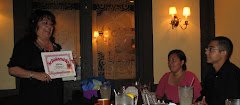
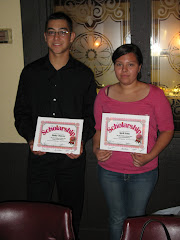
Last night my YWCA leadership group, The Positive Gals, culminated our efforts to give away two $1000 scholarships at a local resteraunt. Rudy Chavez from San Elizario, Tx. and April Soto from El Paso, Tx. received their awards last night. Five hundred was given to them directly, and the other $500 goes directly to their school as credit toward classes. Student applicants to the scholarship had to write an 800 - 1000 word essay from the prompt "Be the architect of your life."
Rudy Chavez said that he heard about the essay contest from his sister who was taking Teresa Nevarez's class at El Paso Community College. She brought it home, and Rudy thought he would give it shot. His efforts paid off. Rudy shared with us some of the experiences that have been the building blocks of his life. When he was in the 8th grade, his father brought home an old 1967 truck that he paid $300 for. His dad told him that it was now his truck and he could drive it if he fixed it up. The truck became a several year project for Rudy and his dad. It's now a painted, classic truck that sits in their drive. People stop at their house, knock the door, and ask if he's willing to see his truck. He said, "I'd never sell it." He appreciates the time and effort he put into it too much to get rid of. This young man's attitude is in stark contrast to many of our youth today who are "given" everything, and were not required to work for what they have. Rudy plans to start in the fall at Western Technical to learn auto mechanics. He currently works days with his father at their new business, Ydur Tires, and at night he works at a Limosine Service. Congratulations, Rudy!!
April Soto heard about the scholarship through community outreach. As an ex-teacher at El Paso High, I was generously given access to some of the English teacher's classrooms. Mr. Denny allowed me some time in one of his classes, and April was one of the students in his class. The students in his class didn't seem so enthusiastic about possibly winning $1,000, but the prospect caught April's attention. She worked for several weeks on her essay never giving up hope that she would get the scholarship. Some of the building blocks of her life have come from visits to her grandmother in a small pueblo in Durango, images of sick children in poor communities on PBS, and giving of her time to elderly homes. She wrote in the conclusion of her winning essay, " I believe the best way to predict the future is to build and create it yourself. The experiences from Mexico and my grandmother’s place have contributed to my decision of becoming a nurse. Even the worst experiences like seeing an innocent child dirty and sick on the streets of Juarez have helped me create my future plans. I have chosen to not dwell on my helplessness in these situations, but use them for making me stronger and as the bricks, wood, and cement to build my future." April is currently working at Burlington Coat Factory, and will start classes in the fall at El Paso Community College at the Rio Grande campus. Congratulations, April!


As a group, we owe great thanks to Community Center Empowerment Systems here in El Paso, Tx. who matched our funds of $1000. A big thank you to all the people (more than I can mention here) who donated money to help make the scholarships a reality. Also, a big thank you goes to Karen Marasco at Sunland Park Barnes and Noble for donating $50 worth of school supplies, pens (really nice ones!), notebooks, and planners for April and Rudy.


We wish April and Rudy all the luck
as they start their college and life careers!
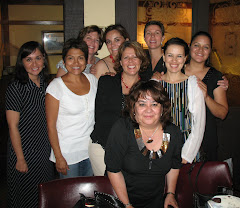
Pictured above: Left to right: Maribel Villalba, Yolanda Alameda, Terry Valero, Lucia Dura, Claudia Cochran, Bonnie Apodaca, Rose Galindo, Cristina Ramirez, Terresa Nevarez.


Sunday, June 1, 2008

Mestiz@ Scripts, Digital Migrations, and the Teritories of Writing


Damián Baca´s book on mestiz@ rhetorics was just released this past week. I'm kicking back with a cold glass of jamaica and reading his book. He provides a history of the conquest of the indigenous peoples of mesoamerica. As well, he argues that the people were not a barbaric civilization in need of "civilizing." He shows how the people in mesoamerica before the conquest had established a highly complex system of governance and communication throughout the land. Challenging the main stream view of what accounts as rhetorical texts, Baca presents examples of indigenous dance and pictographs as rhetorical.

Tuesday, May 27, 2008

Researching at the Benson Collection for Writing, Rhetoric, and Latinidad

This past week I was in Austin, Tx conducting research for my disseration on Mexican women journalists. I've geared the first chapter of my disseration to answer one of the main questions in the special call for paper submitted by Damián Baca and Victor Villanueva: How do we being to understand a broader history of rhetoric within the Americas? I am planning on answering this question through the discourses of Mexican women journalists and how they played into constructing a national Mexican identity in the years 1876-1920. Enjoy my pictures from Austin and the Benson Collection.


The Benson Latin American Collection in Austin is the largest collection of Latin American writings next to the Library of Congress. Doing research is not easy and be quite exhausting. When I arrived in Austin at 7:30 am I hopped on the Flyer 100, the .50 cent shuttle to downtown Austin. I checked in my hotel and headed to the archives. I was greated by a cool breeze of air conditioning. Austin was experiencing really hot and humid weather. Entering the library and getting oriented, I noticed how big the library really is. The wings of the library are separated into rare books and then regular books that can be checked out. On the third floor they have an extensive collection of microfilm. I located some great materials that will enhance my dissertation! I hope my research will make a difference!


College English -- Call for Submissions
Call for Submissions
For two special issues of COLLEGE ENGLISH, we invite submissions, which should be sent electronically to the journal’s office at cesubs@indiana.edu by July 1, 2008:

Lincoln in English Studies: In February 2009, historians will celebrate thebicentennial of Abraham Lincoln’s birth. Why and how should our disciplinestudy him, too? Besides his own rhetoric, contributors might examine how hehas figured in works of fiction, visual culture, English courses, orEnglish scholarship.

Writing, Rhetoric, and Latinadad (guest editors: Damián Baca and VictorVillanueva):

With Latinas and Latinos comprising the United States’ largestlinguistic and ethnic “minority,” this issue will consider the historicalknowledge that the field of rhetoric and composition needs to constructsocially relevant pedagogies. Particularly welcome are essays that defineLatina/Latino rhetorics in comparison to Greco-Latin ones. How do we beginto understand a broader history of rhetoric within the Americas, forexample? How can Latina/Latino rhetorics that pre-date the teaching ofEnglish in the Americas transform composition studies? How might resistantand de-colonial Latina and Latino rhetorics challenge Eurocentric historiesand historiographies of writing and writing instruction? How can greaterunderstanding of the unique historical trajectories of indigenous, Spanish,and English rhetorical ways affect our current attempts to include Latinoand Latina language experiences in our composition classrooms? What arehistoricallinks among AmerIndian rhetorics (i.e., those of Latin American andCaribbean indigenous peoples as distinct from their more Northern brothersand sisters)? How would these have affected, and been affected by, Spanishcolonial rhetorics?

Wednesday, May 14, 2008

Guest Blogger: A Rhetoric of Argument and Life

Isaac Campos 05/09/2008

And so it is that the Spring 2008 at UT El Paso has come to a close. The time has finally come to take a deep breath and ask the ourselves “did we learn anything?” The answer is a straight yes when it comes to English.

One of the most notorious, and sometimes annoying, aspects of this writer is his tendency to be critical about just about everything. Almost in every action, almost, I usually like to take a few seconds and think, “why am I doing this?” This question has lead to many astonishing conclusions which sometimes denoted the lack of purpose I had while performing some activities; classes are not any different. When I’m sitting in my room memorizing for the third straight year in high school the same birth date of the same person, I have to wonder, “why am I doing this? And more importantly, “How is this helping me at all?” The answer is, that it is not helping at all.

Eventually the time came for me to wonder, “Why am I in this rhetoric class?” The answer, unlike the history classes in high school, lead me to realize just how much I was learning about writing and the forging of strong arguments. As I read my papers, they did not sound as just an unguided train wreck anymore, but as a real argument. The advantage of using the techniques taught in Mrs. Cristina D. Ramirez’s English 1312 class was clearly seen in my essays.

One of such techniques that bettered my writing was “Stasis Theory” which is a way in which to develop a conclusion. When I included it in my final paper, it was very notorious that the conclusion had greatly improved compared to the regular conclusion I developed for my essay. Stasis theory is only one of the many argument-strengthening techniques I learned in English 1312.

Besides improving my writing, the class also taught me to be more aware my surroundings. How so? Well, for one thing, it may be become more aware of the deluding arguments advertisers sue to convince us to purchase their product. Understanding these arguments allowed me to become nigh “immune” to their rhetorical techniques. Another aspect of the class that made the most impact on this writer would be the way in which rhetoric impacts and can impact our lives.

Back in the age of the Greeks, some of the wise ones of their time set themselves to propagate rhetoric throughout the land. They wanted to do so to provide the people of their time with the means to defend themselves in the everyday life. This class has accomplished so by providing the techniques that allowed this writer to canalize the feelings and sentiments inside of him and make them a convincing argument. This aspect is very much crucial for any conversation or form of writing; being passionate about a subject will only get you to a certain place, but not towards victory over the opposite side, which what we all want, right?

Besides all of the techniques, which already justified the class, I can most certainly attest that I greatly enjoyed the time I spent writing about the rhetoric of video games. The way the general consensus is right now, few if any teachers would have allowed me to write something about video games; I was allowed to do so in this class. What better thing to write about than my favorite hobby?

Hence, because of the ample amounts of useful information that I learned, and because of the great time I had all throughout the semester, let us conclude that the class was a success. 1312 not only changed my writing, but it also changed the way I looked at my surroundings. Hence, it is also possible to conclude that English 1312 was indeed rhetorical.


Monday, May 5, 2008

Guest Blogger

Oscar Veliz. 05/05/2008
Already the end of the semester has come leaving some gladness and some sadness. Gladness being that I'll get my Saturdays back and will be able to sleep in after the long week. Sadness being that I'm going to miss Prof. Ramirez's unique English class.


It is not very often that I'm shocked at what is in my syllabus because normally they all read the same. Quiz this day. Paper due that day. Test in a week. And Final on whatever future day. This class had something that I did not expect out of the gate, a blog. At first I was apprehensive with creating my own blog, thinking "What am I going write about?" All I really needed to do though was take the plunge and set up an account on Google. Once I started using Blogger and realizing how simple it was to use, the blog pretty much wrote itself. Visit my blog here.

Of course we had class as well with some required readings. Most of all of which were about rhetoric. Go figure. An actual definition of the word is hard to nail down because I have my own that I'm used for my research paper, as does every other member of the class. As a whole, we created a working definition that stated "rhetoric is an epistemic art created by a rhetor for the purpose of change." As a class we learned about ethos, pathos, and logos; which we've all learned about in high school but not nearly the level that we utilized it in this class. The easiest element for me to grasp was logos/fallacy mainly because I'm a computer programmer so I use a lot of logic to solve problems and write programs. Pathos and Ethos I still mix up from time to time even though Prof. Ramirez hammered them into my skull.

I think that the part of the class that sticks out in my mind is that we always used technology. Whether it was the simple use of a projector for notes or posting syllogisms on WebCT, listening to NPR to analyze an article's rhetorical elements, reading New York Times articles, doing research for our research paper, etcetera. We each created a video essay representing the change in our topic over time, for our research paper, using PhotoStory.

Speaking of research papers, mine is on Sherlock Holmes and how he is rhetorical. Surprisingly, even though Sherlock Holmes is found in the world of fiction, he is very much real to many people all over the world from the United Kingdom to the United States to Japan to India to Russia. There are Sherlock Holmes societies everywhere devoted to studying Sherlock Holmes Canon and have scholarly discussions regarding him. In the US there exists the Baker Street Irregulars (BSI), who publish a quarterly journal with various scholars submitting articles. I selected one of the articles in this publication to analyze its rhetorical elements for this class.

After the middle of the semester I'd started noticing that almost everything I saw, read, or heard had some sort of rhetoric in it. Whether it be bottle water advertisements or segments I'd seen on the news. More often, I started to question if everything I heard is valid. Normally checking a statement for fallacies or one-sidedness. In fact, I think I've always done that, but now I have a term, a definition for this analysis and I've come to begin thinking more critically.

As the semester comes to it's conclusion, I realize that this class has grown on me and that I may have grown because of it. Even still, I'm going to like having my Saturday's back.

Saturday, May 3, 2008

Dulce Recuerdos de mi Abuela: Ramona Gonzalez (Jan. 6, 1906 - May 5, 1994)


May 5 marks the anniversary of my grandmother's passing from this physical world.


I lived with my grandmother the last five years of her life. Every morning right at 6:45, she would get up, boil some water, make a cup of instant coffee, and sit down and eat a pan dulce. While playing cards later in the afternoons, she would look at me, a wild eyed and energetic college student, and confess "You know I steal energy from you." Silence. The click from the edges of the cards being placed on the table would resonate through the kitchen. Not once did she look up from her game of solitare. I glanced at her, noticing the white curtains catching the morning breeze behind her. I would answer, "Ah, si, that´s nice, grandma." I thought that she was a bit strange for saying that, but then again, I felt like taking a nap every day at around 1 pm. Hmmm, maybe she was.

My husband, Alex, says that we live in a disposable society, and that we keep the crap and throw away the valuable stuff. He comments, "As an American society, we are in such a bad place because we throw away our old people letting them rot in old folks homes. Our actions are a sad commentary on our society." Our elders are our connections to the past, and we break that connection when we forget about our roots. I will never forget my abuela, Ramona. She had a gift of knowing how to use language, and could hold a group of people in suspense with her cuentos and chistes.

The sweetest memory I have of my grandmother is my 21st birthday. For my birthday, I wanted to have a get together with my friends at my house where I was staying with my grandmother. Worried that grandma would not want to stick around, I asked her if there was anything I could do to accommodate her. She said no, and that she wanted to meet my friends. The evening of my birthday arrived and my friends started to arrive. Perched in her regular seat at the head of the table, my grandmother was the focus of attention as my friends entered the small house. Each of them approached her and greeted her with the utmost respect. After the food, and after the singing of "Happy Birthday," I cut the cake.

We all sat down at the table and watched as my grandmother said to my Swedish friend Tina, "Give me your hand." She put down her fork piled with cake and extended her hand to my grandmother. She turned my friend´s hand over, palm up, and brushed her hand over it. My grandmother murmured, "Hmmm, muy interestante," and a hush fell over my friends. "What is it? What do you see?" Tina demanded, with eyes wide ready to peer into her future. Grandma preceded to read the lines zigzagging on her hand and fingers. That evening, each of my friends touched my grandmother's hands letting her smooth over their palm and tell them about their future. With each hand she touched, she told a story, and all my friends listened. I think they forgot that it was my birthday party. But that didn't matter. My friends enjoying my grandmother's wisdom was the greatest gift.

Esa noche viene a mi mente hoy dia.

Abuela
- Cristina D. Ramirez

The fragile days I spent with you
the last years of your days
rushed by like the currents of el Río Bravo.
No estas aqui.

Puedo oír tus cuentos y dichos
In my mind
Like echoes through a canyon.
The memories of your words mix with the smells of guiso y calavasas
cooking on the stove.
The knowledge you imparted with me
chases away my ignorance
like the first signs of spring's arrival
on a winter’s afternoon;
Your wisdom resides in me.
Pero tu, no estas aqui.

Before, I would not let the wisdom in,
I thought it to be old-fashioned,
A tattered book with yellowed edges,
abandoned on a shelf unread.

Abuela, me has dejado un gran plato
servido con palabras y memorias
De tu juventud.

Abuela, I feel you now,
Como el sol en las espaldas
De una mujer sin blusa.
I embrace my memory of you
Like a child embraces her mother
For the last time.
Abuela, si estas aqui.


Thursday, May 1, 2008

Cinco de Mayo: Mexican History is American History

Cinco de Mayo seems to be a day for people in America to get drunk, party, have sales at department stores, or take a day off from work. Do they really know what they are celebrating? I don't think so. In 1962 the Spanish, English and French had come to Mexico on the pretext to collecting debt from the Mexican government. While the Spanish and English left, (the Spanish had been defeated in 1810), the French decided to stay. Under Napoleonic rule, the French brought the Prince of Hapsburg, Maximilian and his wife, Carlota. Napoleon's French Army entered Mexico undefeated in 50 years, and invaded Mexico with the finest modern equipment and with a newly reconstituted Foreign Legion. The Mexican people wanted to create their own nation, their own identity; they were not going to stand idly by. On May 5, 1962, a Mexican army of 4,000 sliders faced an army of French soldiers and Mexican traitors who joined the French equaling about 8,000 men.

General Zaragossa ordered Colonel Díaz (who would later become president and dictator in Mexico) to mark with his cavalry, the best in the world, meeting the French flanks. In response to the confrontation, the French did a most stupid thing; they sent their cavalry off to chase Díaz and his men, who proceeded to butcher the undefeated French army. The French did not give up. The remaining French infantrymen charged the Mexican defenders through thick, slippery mud, created by an ensuing thunderstorm, and through hundreds of head of stampeding cattle stirred up by Indians armed only with machetes. By the battles' end, many French were killed or wounded and their cavalry was being chased by Díaz's superb horsemen miles away. (Very interesting side note to history not many people know). The Mexicans had won a great victory that kept Napoleon III from supplying the American Confederate rebels for another year, allowing the United States to build the greatest army the world had ever seen. This grand army smashed the Confederates at Gettysburg just 14 months after the battle of Puebla, essentially ending the Civil War. Could Mexico defeating the French have given unity to our American nation? Nothing is impossible.

The French were not kicked out by any means after the battle. A year later, they occupied Mexico, with Maximilian as ruler. In 1867, Benito Juárez, the first full blooded indigenous national, and his men defeated the French again and expelled them from the country.


So this is why people celebrate Cinco de Mayo. The history connects Mexico and America in a show of force and patriotism that shaped both of our histories, Mexican and American. If we could only do the same today we would be a strong nation and people.
Pictured above: A basketball hoop post. This picture was taken in a colonia of Durango, Mexico.